
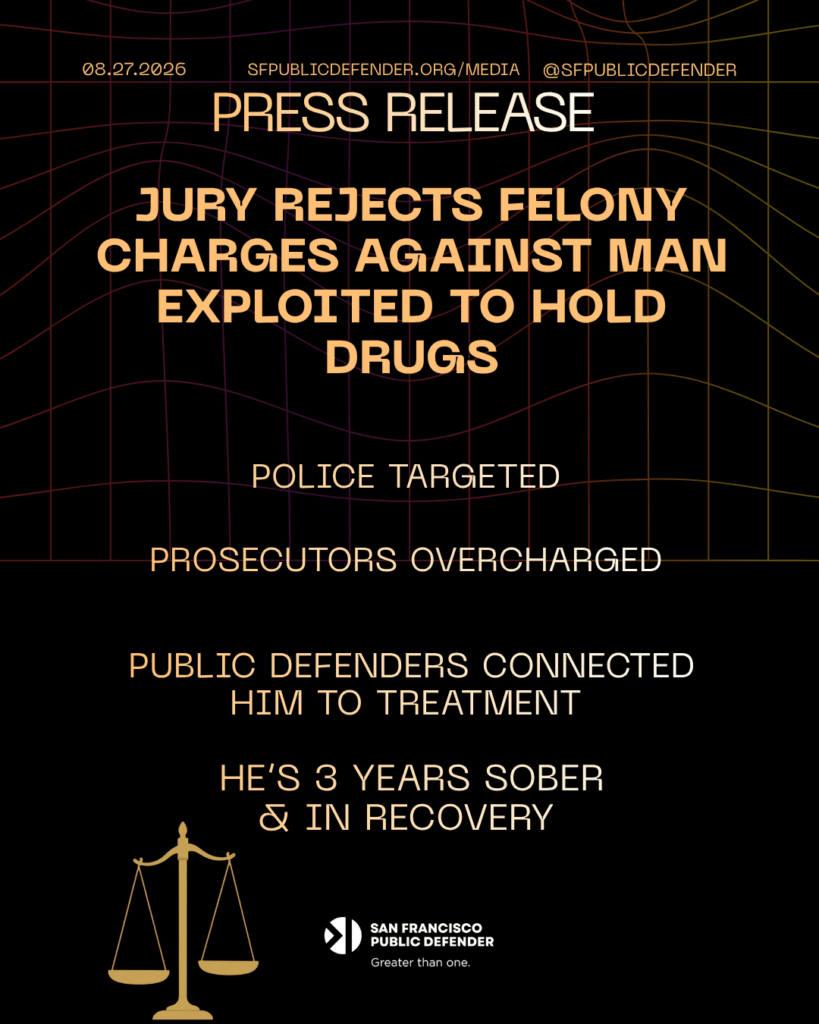
A man was in the throes of a painful relapse in 2022 when sellers first gave him drugs for free and later said he owed them a debt which he could only repay by holding the bag—a situation that is not uncommon. His defense team was able to get him into treatment, and he is now three years sober. Still, prosecutors would not drop the unfounded felony sales charges nor agree to a diversion program to support his recovery. The trial exposed how police target and prosecutors overcharge people who are already being exploited for their disease.
Jury Rejects Felony Charges Against Man Exploited to Hold Drugs
Trial exposed how police target & prosecutors overcharge people being exploited for substance use disorders
A San Francisco jury recently rejected prosecutors’ attempts to convict a man who suffered from a serious substance use disorder of multiple felony drug sales counts. Since 53-year-old Kurt Lackner’s 2022 arrest—where local drug sellers told him that he needed to hold a backpack for them when the police were nearby—his defense team was able to get him into treatment and he is now three years sober. Still, prosecutors would not drop the felony charges despite no evidence that he was involved in any sales, and they would not reasonably resolve the case or agree to diversion to support his recovery. At trial, jurors rejected the felony sales charges and instead convicted him of misdemeanors for possession.
“The District Attorney decided to prosecute a person for drug sales who was obviously just a holder. The jury saw that Mr. Lackner did not share their intent to sell, but was driven by physiological needs of his disease,” said Deputy Public Defender Tatiana Howard, Lackner’s defense attorney.
A “holder” is someone who is asked or told by a seller to hold narcotics for them and thereby take on the risk of arrest. This arrangement exploits individuals’ reliance on the sellers to feed their disease. Lackner testified that he was in the throes of a painful relapse in 2022 when local sellers first gave him drugs for free and later told him that he owed them a debt which he could only repay by holding the bag. An expert witness familiar with the local drug market testified that this situation is not uncommon.
Lackner has been sober for the last three years after his defense attorney connected him with a social worker from the Public Defender’s Office and petitioned the court to connect him with the S.F. Pretrial Diversion Project. From there, Lackner participated in a residential program and later completed two years of outpatient treatment. His case was assigned to a trial courtroom on June 15 for pretrial motions. Jurors were seated at the beginning of July and rendered a verdict on July 10.
Howard added, “The prosecutor was aware of how much effort Mr. Lackner put into his recovery, but still refused to resolve the case or agree to diversion and contribute to his recovery. Instead, they pursued the felony sales charges to trial where the jury rejected them.”
“Mr. Lackner is in better health today because his public defender and social workers got him into recovery programs that have helped him get and stay sober for the past three years. That is a much greater contribution to public health and safety than the time and resources that police and prosecutors spent trying to imprison him for a crime he did not commit,” said San Francisco Public Defender Mano Raju, whose office continues to advocate for the city to augment public health resources to help vulnerable people who are criminalized for their diseases.
On Aug. 19, a judge sentenced Lackner to community service, a number of fines and fees that were satisfied by credits for time he served in county jail, and a requirement to not pick up any new cases for one year.
##